
WhatsApp Business API pricing changed on 1 October 2026: Meta now charges for every service message your team sends inside the 24-hour customer service window, after a free tier of 1,000 per business phone number each month. For sales and support teams working WhatsApp from Bitrix24 or Odoo, that turns every agent reply and every chatbot message into a cost line. This guide explains what is charged now, how to estimate your monthly bill, and the inbox habits that keep it under control.
Key takeaways
- Replies are no longer free. Since 1 October 2026, Meta charges per delivered service message, at the same rate as utility and authentication messages in that market. Utility templates sent inside an open window are charged again too.
- 1,000 free per number, per month. Each business phone number gets 1,000 free delivered service messages a month. They do not roll over.
- No payment method, no replies after 1,000. Without a payment method in Billing Hub, Meta stops delivering service messages once the free tier is used.
- Count messages, not conversations. Three short replies cost three times one complete reply. Inbox habits and chatbot design now show up on the invoice.
What changed in WhatsApp Business API pricing on 1 October 2026?
Meta has charged per message, rather than per conversation, since 1 July 2025. A charge applies only when a message is delivered, and the rate depends on two things: the message category and the country calling code of the person receiving it (Meta, Pricing on the WhatsApp Business Platform).
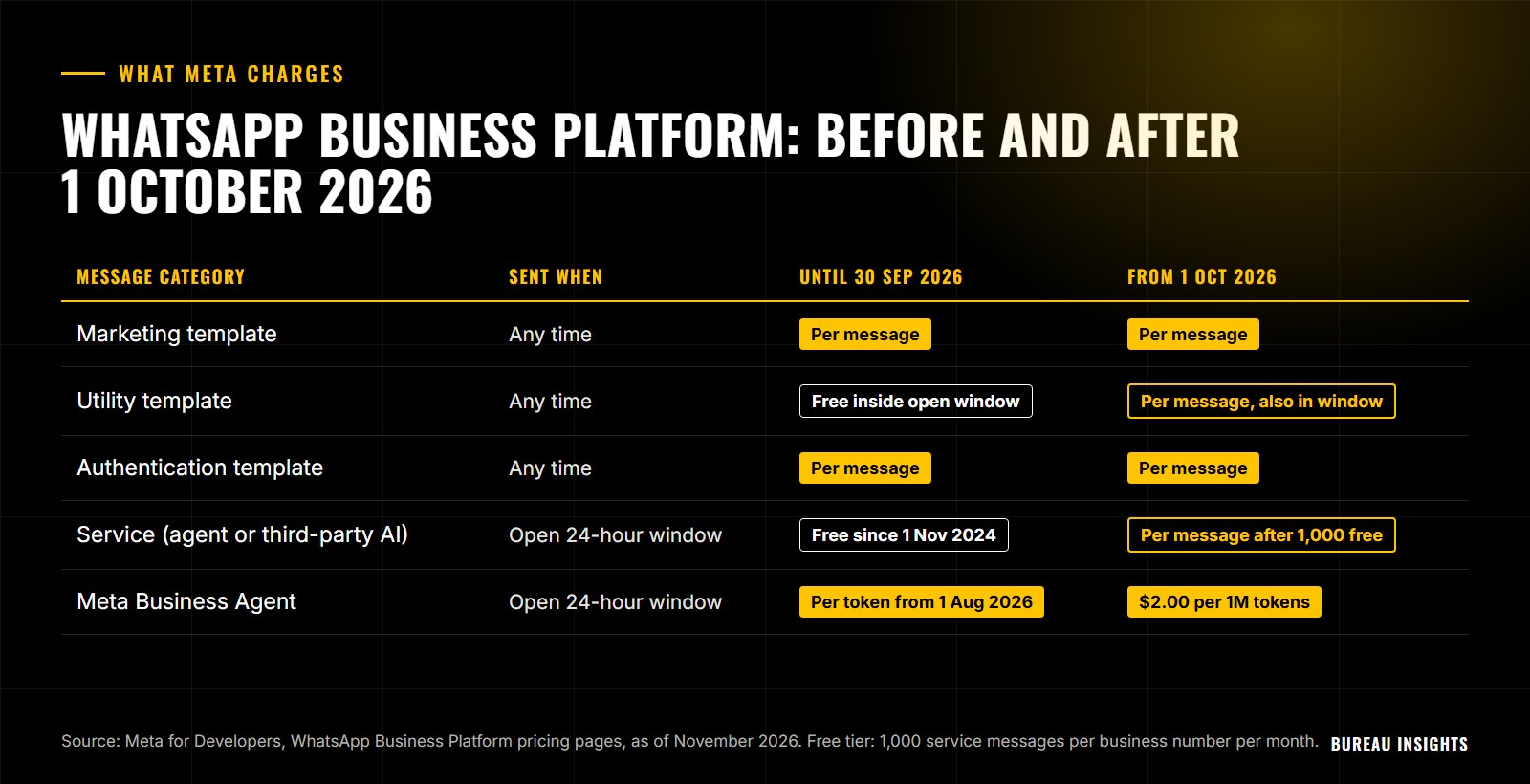
Until 30 September 2026, one large group of messages was free: service messages, meaning any free-form reply sent while the customer's 24-hour window was open. They had not been charged since 1 November 2024. Utility templates sent inside an open window had been free since 1 July 2025. According to Meta's page on the H2 2026 updates, both changed on 1 October 2026 (Meta, Upcoming pricing updates for Meta Business Agent, service and utility messages):
- Service messages are charged per delivered message. By market, the rate is the same as the utility and authentication rate. There are no volume tiers for service messages.
- Utility templates sent in response to a user, inside an open window, are charged per message again.
- Meta Business Agent messages, the replies written by Meta's own AI agent, have been charged since 1 August 2026, per token.
Messages from customers to your business stay free. So do messages inside a free entry point window, which we cover below.
Which WhatsApp messages are charged now?
Every message a business sends has exactly one of five categories, and only one charge. Three are templates, which you can send at any time. Two are free-form replies, which you can only send while the 24-hour customer service window is open. Each new message or call from the customer opens or resets that window.
| Category | Typical use in a CRM | When it can be sent | Charged since 1 October 2026? |
|---|---|---|---|
| Marketing template | Campaigns, offers, re-engagement | Any time, to opted-in contacts | Yes, per message (unchanged) |
| Utility template | Quotation sent, order confirmed, delivery update, payment reminder | Any time | Yes, including inside an open window |
| Authentication template | One-time passwords, login codes | Any time | Yes, per message (unchanged) |
| Service | Agent replies and third-party chatbot replies | Only in an open 24-hour window | Yes, after 1,000 free per number per month |
| Meta Business Agent | Replies written by Meta's AI agent | Only in an open 24-hour window | Yes, per token since 1 August 2026 |
Two details matter for day-to-day work. First, a reply from your own chatbot or a third-party AI tool is a service message, so it counts against the free tier and is charged after it. The AI provider bills you separately for its own usage. Second, a free-form reply with promotional content is still charged once, as a service message, not as marketing.
How the free tier and the free entry point window work
1,000 free service messages per number
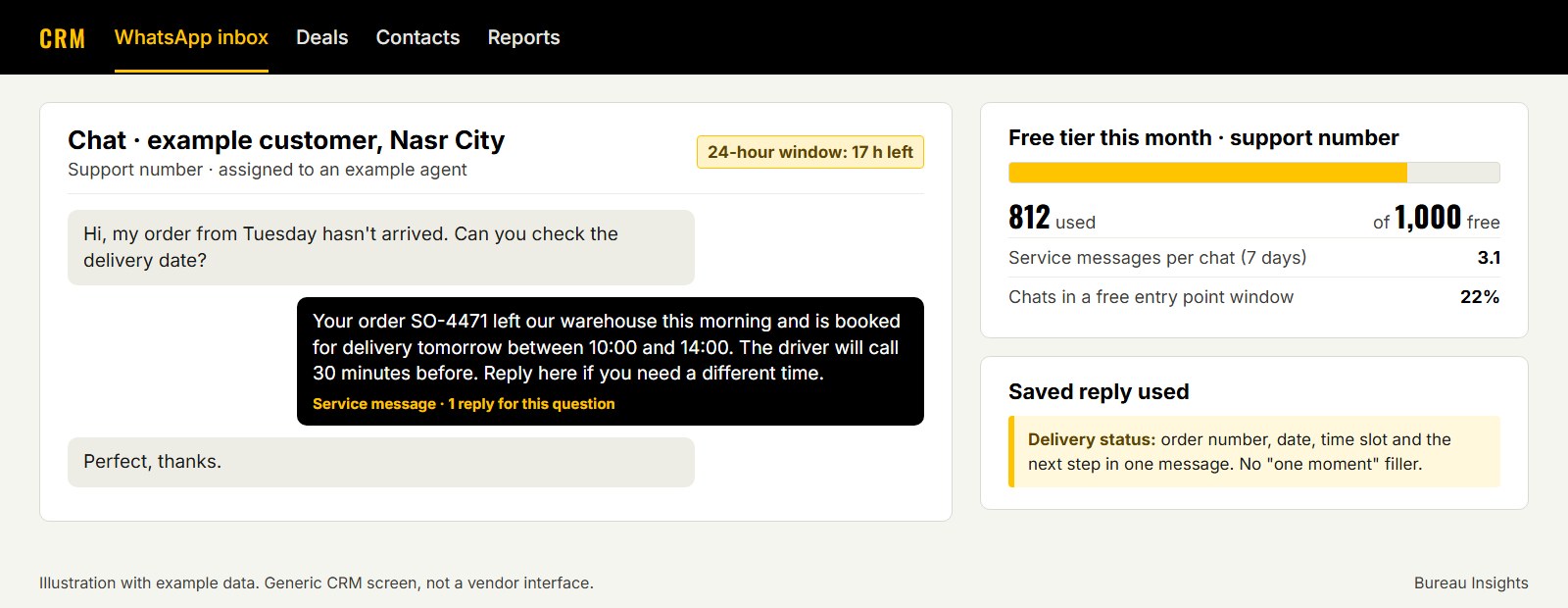
Meta gives each business phone number 1,000 free delivered service messages per month. The count resets at midnight in your Messaging account's time zone on the first of the month, and unused messages are lost. The 1,001st service message of the month is the first one charged (Meta pricing page).
If your Messaging account has no payment method, Meta still delivers service messages within the free tier but stops delivering them after it. For a busy support number, that can happen within the first week, and agents will not see an error in the CRM until customers complain. Check Billing Hub before anything else.
Click-to-WhatsApp ads open a free window
When a customer messages you from an ad that clicks to WhatsApp, on the Android or iOS app, and you reply within the customer service window, that reply is free and opens a free entry point window for up to 7 days. Inside it, marketing, utility, authentication and service messages are not charged. Meta Business Agent messages are still charged. For teams that buy leads through these ads, a fast first reply is now worth money as well as conversion.
How much will WhatsApp cost your team each month?
Rates differ by market and change only on the first day of a quarter: 1 January, 1 April, 1 July or 1 October. Meta gives at least one month's notice of a rate card change. Egypt (+20) and Saudi Arabia (+966) each have their own row on the rate card, and as of 1 April 2026 Meta publishes a rate card in Saudi riyals as well as US dollars. Take the utility rate for your customers' market from the current rate card and use this formula:
Monthly service cost = (service messages delivered − 1,000) × utility rate for that market, per business phone number, plus your templates at their own rates.
Worked example: a support number in Cairo
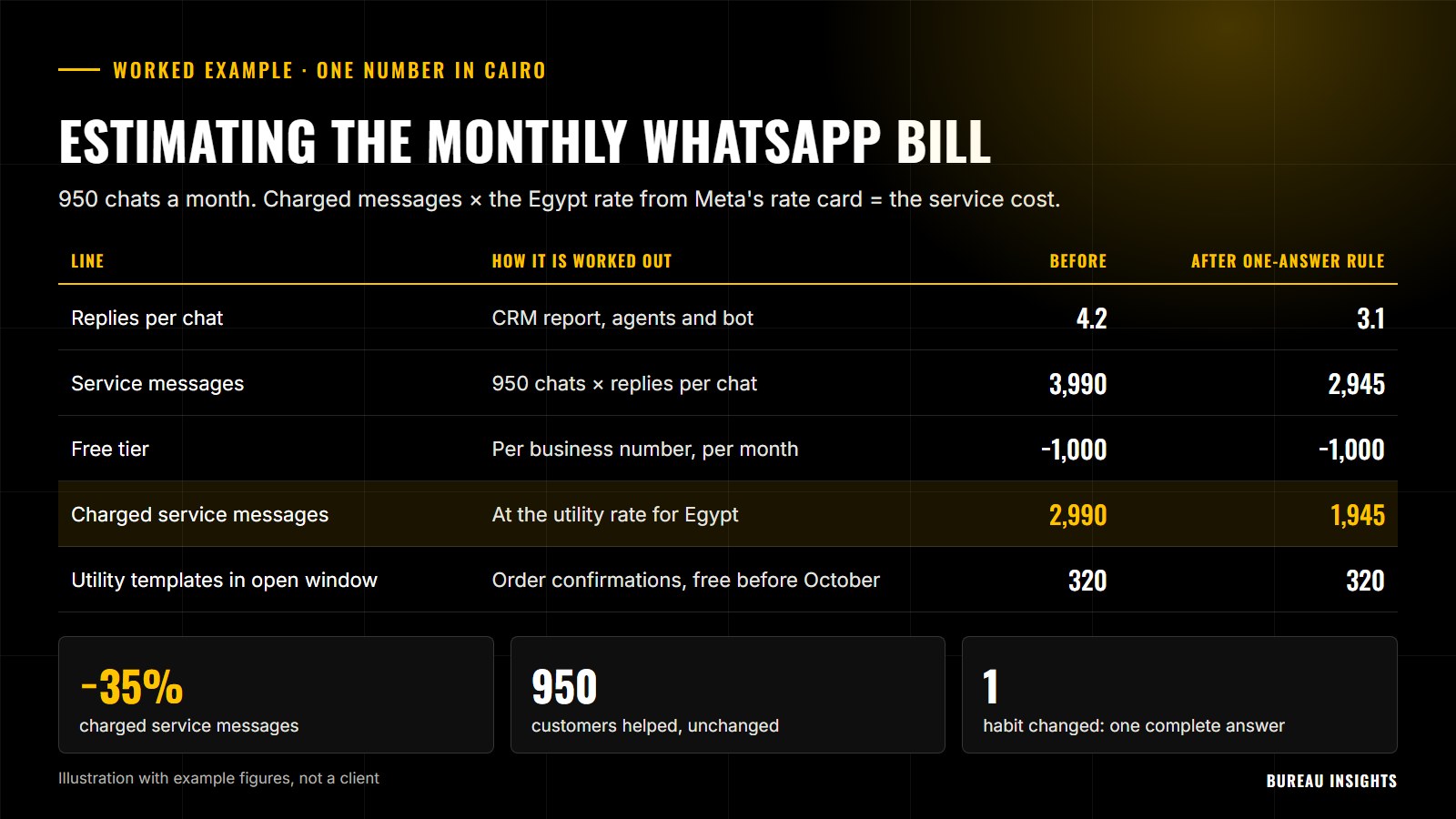
The numbers below are an example, not a client. A distributor runs one WhatsApp number from its CRM for orders and after-sales questions.
- Volume. About 950 customer chats a month, mostly from Egyptian numbers. The CRM report shows an average of 4.2 agent replies per chat, so roughly 3,990 service messages.
- Free tier. The first 1,000 are free. That leaves 2,990 charged service messages at the Egypt utility rate.
- Templates inside the window. The team sends an order confirmation template in 320 of those chats. Before October these were free inside the window; now they are 320 charged utility messages.
- One habit change. The supervisor reviews 50 chats and finds agents often send "one moment", then the answer, then "anything else?". A rule to send one complete answer brings the average down to 3.1 replies per chat: about 2,945 service messages, so 1,945 charged.
- Result. Charged service messages fall from 2,990 to 1,945, about 35% fewer, with no change in the number of customers helped.
What should change in your CRM inbox
The pricing rewards teams that already run their WhatsApp inbox well. These are the habits we put in place when we set up CRM operations on Bitrix24 or Odoo.
- One complete answer per question. Saved replies should answer the question, include the next step and end there. Remove "typing" fillers and split-message styles from your templates and chatbot flows.
- Chatbots that resolve, not greet. A bot that sends a greeting, a menu and a confirmation before a human takes over has used three service messages. Shorten the opening and hand off with the context already in the chat.
- Quick first reply on ad leads. Route click-to-WhatsApp leads to an available agent first, so the reply lands inside the window and opens the free entry point window.
- Templates only where they add something. A utility template inside an open window is now charged like a service message. If a free-form reply carries the same information, the template brings no saving, so choose whichever is clearer for the customer.
- A number per department, on purpose. The free tier is per business phone number. Odoo's own documentation suggests separate WhatsApp accounts per department for better management; if you already split sales and support, each number has its own 1,000.
Bitrix24 and Odoo: what to check this week
Bitrix24
WhatsApp reaches Bitrix24 through the Contact Center and an Open Channel, using a connector such as Edna.io or another provider from the Bitrix24 Market. Bitrix24's help article on the Edna.io channel, updated 5 October 2026, notes that only the customer can start a conversation, except through approved templates, and that connecting, licensing and messaging are paid services on the provider's side (Bitrix24 Helpdesk, Contact Center: Edna.io WhatsApp). So you now have two bills to read: the provider's and Meta's charges as passed through.
- Ask your provider how Meta's service message charges appear on your invoice from October 2026, and whether a payment method is set on the Messaging account.
- In Open Channel settings, review automatic greetings, after-hours messages and chatbot steps. Each one sent is a service message.
- Add a monthly report of outgoing WhatsApp messages per Open Channel to the supervisor's dashboard.
Odoo
Odoo's WhatsApp app is Enterprise-only and works with a WhatsApp Business Platform account, not the WhatsApp Business app. It sends approved templates from records, such as quotations from Sales and receipts from Point of Sale, and opens a Discuss chat for the operators of the channel when a customer writes in (Odoo 19 documentation, WhatsApp).
- List the templates that fire automatically from Sales, Point of Sale or Events, and decide which ones customers actually need.
- Check how many operators reply in the same chat. Two people answering the same question is two charged messages.
- Confirm the Meta Business account behind Odoo has a payment method in Billing Hub.
Metrics to track from November
| Metric | How to measure it | Why it matters |
|---|---|---|
| Service messages per chat | Outgoing free-form messages divided by chats, per agent and per bot | The main lever on cost; shows filler habits |
| Free tier used by day 10 | Service messages delivered per number since the 1st | Tells you early whether the month will be charged |
| Share of chats in a free entry point window | Chats that started from click-to-WhatsApp ads and got a reply in time | Free messages you only get with fast first replies |
| Charged messages per won deal or closed ticket | Charged messages divided by outcomes | Links messaging cost to results, not activity |
| Template use inside open windows | Utility templates sent while the window was open | Charged since October; check each one is needed |
For developers, Meta's status webhooks carry the pricing details: a service message inside the free tier shows the type free_customer_service with the subtype free_tier, and a charged one shows regular with billable set to true. The Pricing Analytics API returns counts and cost per pricing category. Both are good sources for the dashboard above.
Common mistakes
- Assuming nothing changed because the CRM looks the same. The change is on Meta's side. Your inbox works exactly as before until the free tier runs out on a number without a payment method.
- Measuring conversations. Many reports still count chats. Meta charges messages, so a report that cannot show messages per chat cannot explain the bill.
- Leaving old bot flows untouched. Menus written when replies were free often send four messages where one would do.
- Treating AI replies as free. A third-party AI reply is a charged service message plus the AI provider's own fee. Meta Business Agent replies are charged by token, about 4 to 5 US cents per message on Meta's own estimate.
Messaging cost is one more reason to design the process first, as in why the process comes before the platform, and to give WhatsApp a fixed place in the hour-by-hour CRM day.
Frequently asked questions
Are WhatsApp service messages free in 2026?
Not any more. Since 1 October 2026, Meta charges per delivered service message, after a free tier of 1,000 service messages per business phone number per month. Before that date, service messages had been free since 1 November 2024.
How much does a WhatsApp service message cost?
Meta charges service messages at the same rate as utility and authentication messages for the recipient's market. Rates differ by country, so check Meta's current rate card for Egypt, Saudi Arabia or wherever your customers are. Rates can change only on the first day of a quarter.
Do chatbot replies on WhatsApp count as service messages?
Yes. Any free-form reply that is not written by Meta Business Agent is a service message, whether a person or a third-party AI tool wrote it. The AI provider's own charges come on top.
What happens if we have no payment method on our WhatsApp account?
Meta delivers service messages within the monthly free tier of 1,000 per number, then stops delivering them. Add a payment method in Meta's Billing Hub, or confirm with your solution provider that one is in place.
Does this change affect Bitrix24 and Odoo users?
Yes. Both connect to the same WhatsApp Business Platform, so Meta's charges apply whichever CRM you use. In Bitrix24 they usually reach you through your WhatsApp connector provider; in Odoo through your Meta Business account.
Sources
- Meta for Developers, Pricing on the WhatsApp Business Platform, reflects updates effective 1 October 2026, accessed 27 November 2026.
- Meta for Developers, Upcoming pricing updates for Meta Business Agent, service and utility messages, accessed 27 November 2026.
- Meta for Developers, New pricing policy for AI Providers leveraging the WhatsApp Business Platform, updated 15 October 2026.
- Odoo 19 documentation, WhatsApp, accessed 27 November 2026.
- Bitrix24 Helpdesk, Contact Center: Edna.io WhatsApp, last updated 5 October 2026.
Want to know what WhatsApp will cost you from now on? We review your Bitrix24 or Odoo WhatsApp setup, measure messages per chat, and redesign bot flows and saved replies so the free tier goes further. Book a free consultation or see how we run CRM operations.